

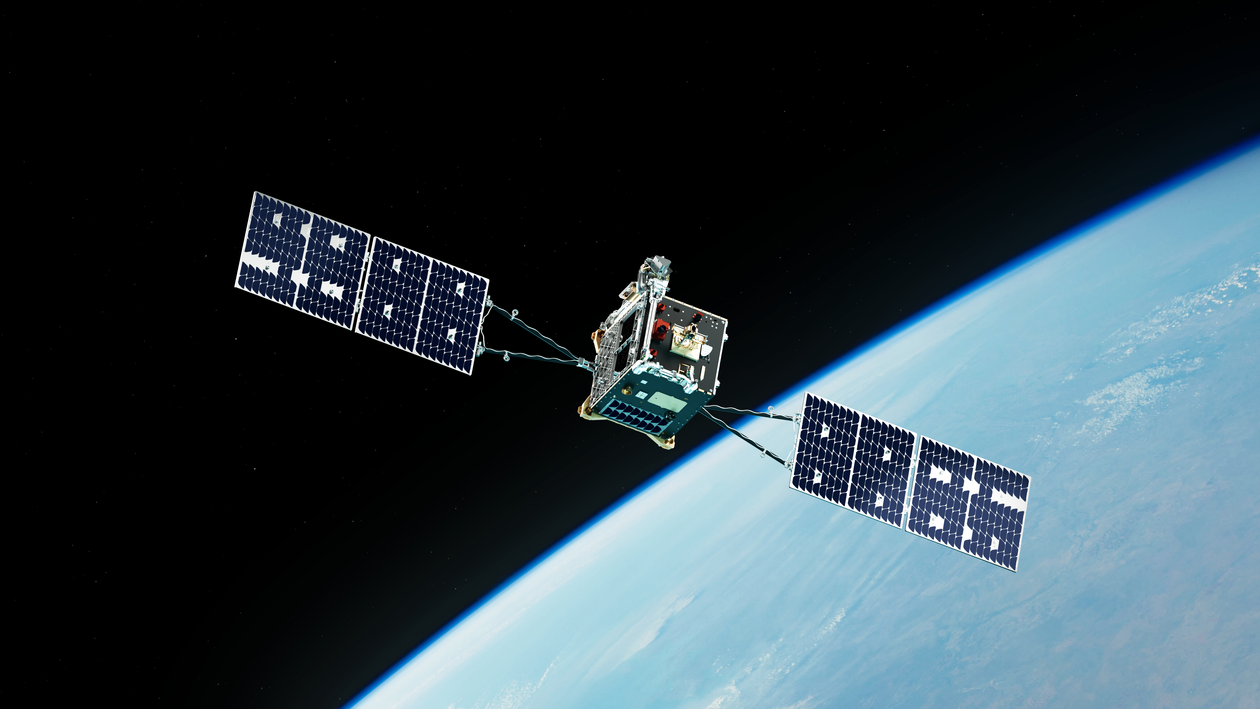
Starfish Space says it can no longer receive data from its first full-scale Otter space vehicle, bringing a $15 million NASA mission to inspect inoperable satellites to a premature end.
In a LinkedIn post, the Tukwila, Wash.-based startup said its Otter 24C spacecraft was not able to complete all the objectives for the mission, known as Small Spacecraft Propulsion and Inspection Capability (SSPICY). “Starfish and NASA are exploring opportunities to fulfill mission objectives through other Starfish missions,” the company said.
The Otter spacecraft was sent into low Earth orbit aboard a SpaceX Falcon 9 rocket on Oct. 1. “Following a successful launch and deployment, Starfish established two-way contact with the spacecraft and successfully commanded Otter 24C, downlinking significant telemetry during early operations,” Starfish said.
However, the mission team lost contact with the oven-sized spacecraft during the commissioning process. “An investigation into the loss of communications has determined that fault protection on the satellite bus provided by Astro Digital had an error that turned off the radio and prevented re-establishing communications,” the company said.
Starfish, NASA and Astro Digital determined that the spacecraft was unrecoverable.
In today’s update, Starfish said it is working closely with Astro Digital to fix the fault protection system and update testing procedures for future Otters.
“Developing new capabilities in space requires taking on difficult challenges, learning quickly and applying those lessons to what comes next,” Starfish said. “The work completed through Otter 24C will directly contribute to the success of future Otter missions as Starfish continues developing the technologies and operations required to make satellite servicing a routine capability in orbit.”
Greg Stover, director of the Advanced Research and Technology Division at NASA Headquarters, said in a news release that “commercial capabilities like Starfish’s are critical for a competitive U.S. space economy and strong American leadership in low Earth orbit.”
“Technology demonstrations allow us to quickly test new systems, learn from their performance, and iterate so that we are pushing the boundaries of what’s possible with every mission,” Stover said. “NASA will continue taking on bold challenges in close collaboration with our industry partners.”
Several other Otter missions remain on tap — including a satellite disposal job for the Pentagon’s Space Development Agency, two commercial satellite servicing missions in geostationary Earth orbit, and two servicing missions for the U.S. Space Force.
Starfish Space is also continuing to test an Otter Pup prototype that was launched into orbit last year. Last week, it posted a video to LinkedIn showing a close approach to a target satellite known as ElaraSat. The company says it is preparing for a docking attempt “and a chance to make history.”
https://ift.tt/9gVNnl4 November 4, 2026 at 06:50AM GeekWire
Post a Comment
0Comments