

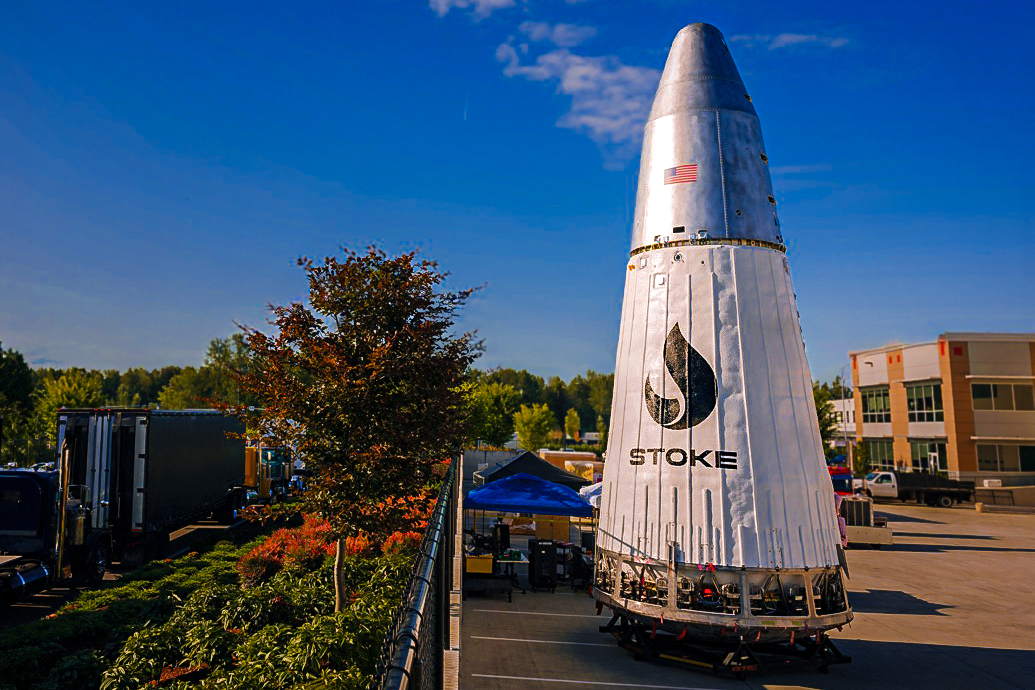
Stoke Space says it has raised roughly $1 billion to get ready for the first launch of its fully reusable Nova rocket — and to scale up the rocket’s design for even bigger payloads.
To accommodate its grander ambitions, the Kent, Wash.-based startup is also scaling up its rocket test facility in Moses Lake, 175 miles to the east.
“We have confidence in the foundation that we’ve laid today, and now it’s time to scale,” Stoke Space CEO and co-founder Andy Lapsa told GeekWire.
The newly announced Series E financing round was co-led by Point72 Ventures and Spark Capital, with participation from General Innovation, Glade Brook Capital, US Innovation Technology, Washington Harbour Partners, Woven Capital, Y Combinator and other investors.
The final figure will be “within rounding error” of a billion dollars, Lapsa said. “Not quite, or a little more,” he said. “The speed with which this has come together is very fast.”
Lapsa said that scaling up the Nova rocket’s design was always part of Stoke Space’s game plan, but that the timeline is being accelerated in response to the growing demand for launches and the shrinking availability of launch opportunities.
The timing of Stoke’s pivot to a bigger launch vehicle wasn’t sparked by a single event, Lapsa said. “The pressure has been growing over the last couple of years,” he said. “It certainly hasn’t slowed down recently.”
From Pathfinder to Block 2
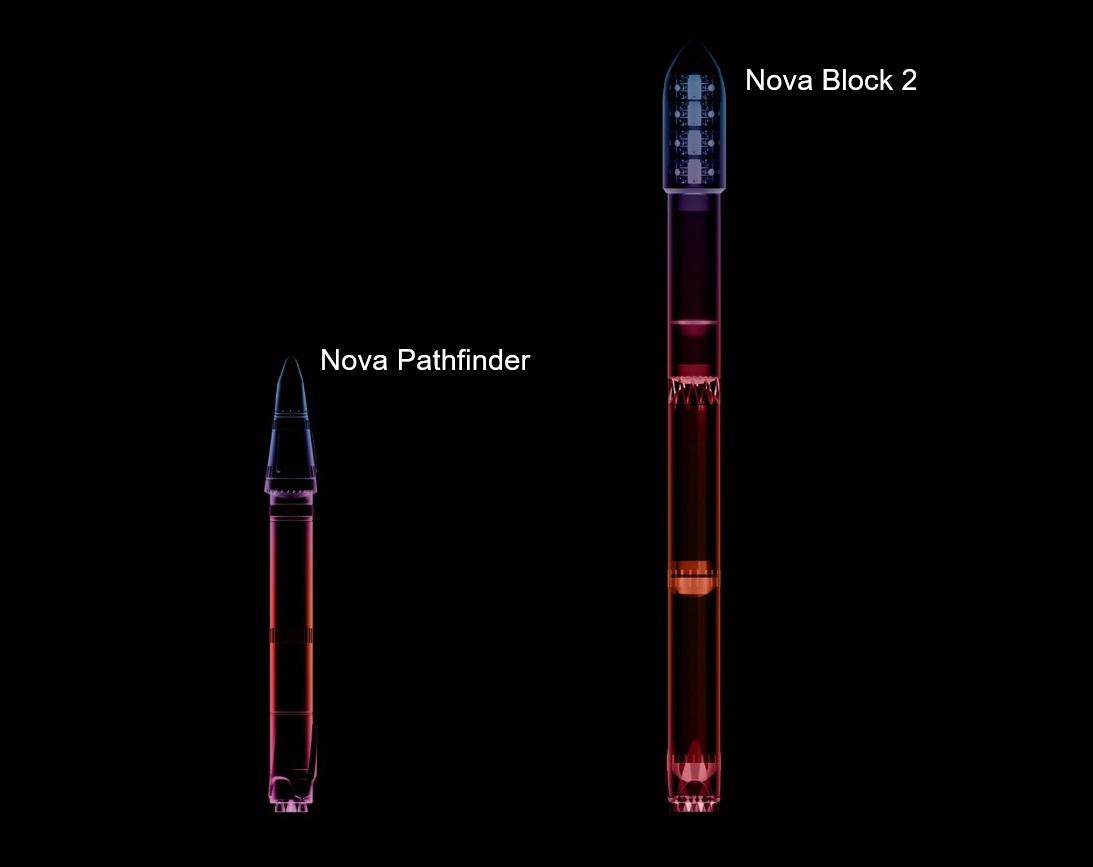
The revised plan calls for Stoke to begin launching missions with the initially designed rocket, now known as Nova Pathfinder. Pathfinder’s first stage will be powered by seven of Stoke’s Zenith engines, and the upper stage’s Andromeda engine will have a ring of 24 thrust chambers integrated into an actively cooled metallic heat shield. The rocket will be capable of putting 3 metric tons of payload into low Earth orbit, or LEO.
Pathfinder’s first launch is now scheduled for early 2027 — a slight slip from earlier expectations. It will carry a spacecraft for AstroForge, a California-based asteroid mining company. “We’re going out to the asteroid belt, and yeah, Astroforge is our partner for that one,” Lapsa said. “They’re looking to prospect and ultimately mine asteroids, and bring back rare earths and other important materials.”
The super-sized version of Stoke’s rocket, known as Nova Block 2, is due to make its debut in 2029. Its first stage will have twice as many Zenith engines as Pathfinder. Its upper stage will have 12 independent engines, each with two thrust chambers. That will increase Nova’s lift capability by a factor of five, enabling up to 15 metric tons of payload to be delivered to LEO. More than 4 tons can be sent to geosynchronous transfer orbit, or GTO.
In comparison, SpaceX says its partially reusable Falcon 9 rocket can deliver 18.5 tons to LEO or 5.5 tons to GTO in reusable mode.
Both versions of the Nova rocket are designed to be fully reusable, with the first-stage booster flying itself down to a recovery ship and the upper stage making a separate re-entry. Stoke is only the second company in the space industry to pursue that strategy. SpaceX has designed its Starship launch system for dual-stage reusability but hasn’t yet reached that goal.
Stoke is developing an active-cooling system for upper-stage reusability. Some of the rocket’s cryogenically cooled liquid hydrogen propellant is circulated through channels in the upper stage’s metallic heat shield to absorb the intense heat of atmospheric re-entry. SpaceX has been experimenting with different heat shield strategies for Starship, but some experts have expressed doubts about SpaceX’s approach.
Both versions of Stoke’s rocket are designed to fill a market niche that’s different from Starship’s. The Nova rockets’ capabilities fall close to both ends of the medium-lift spectrum, while SpaceX’s super-heavy-lift Starship is designed to loft 100 to 150 tons of payload to LEO.
Expanding the infrastructure
Stoke Space’s 168,000-square-foot factory and headquarters facility in Kent was designed from the beginning to manufacture rockets that are bigger than Nova Pathfinder.
“We bring in raw sheet metal, we build our core and we ship a rocket,” Lapsa said. “We can use the same methods and effectively the same tooling to build larger diameters and larger lengths, and that’s very intentional.”
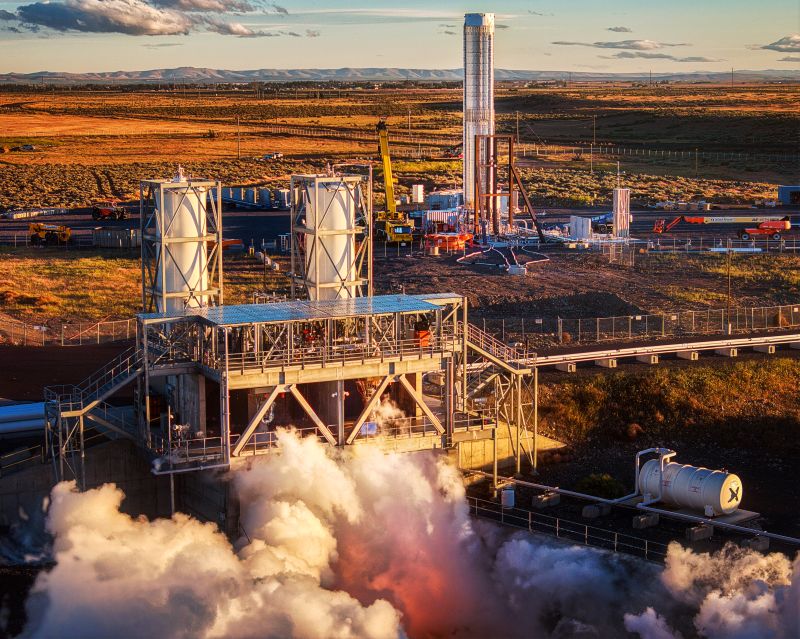
The company’s rocket test facility in Moses Lake is being expanded from 75 to 550 acres to accommodate work on two types of rockets simultaneously.
“We’ve done, I would say, an extremely efficient job at leveraging the 75 acres that we use today,” Lapsa said. “The expansion across the street is going to enable us to test again at rate. … Certain of our facilities have an overlapping blast radius, so they interfere with each other. A big advantage of being able to spread our wings a little bit, and get a little bit more space, is that those test stands can operate in full independence of each other.”
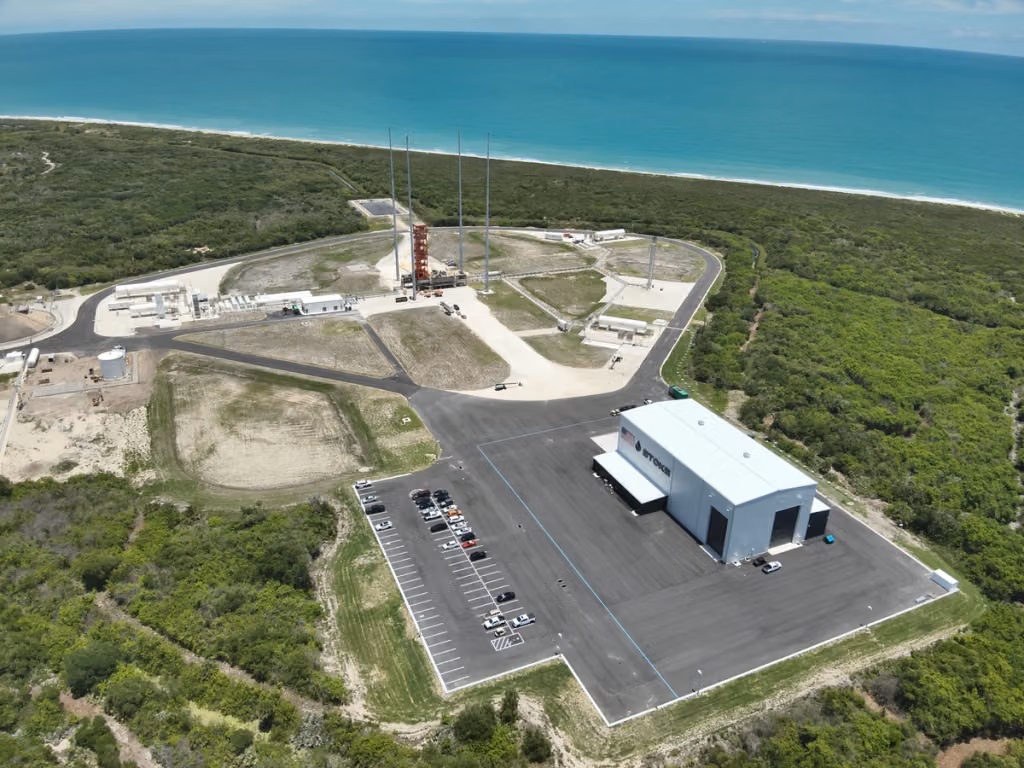
Stoke’s launch facilities at Cape Canaveral Space Force Station in Florida can also accommodate a dual-track approach. A new payload processing facility at the Cape is intentionally sized to support both Nova Pathfinder and Block 2.
In June, Stoke Space’s Moses Lake facility completed what the company called proto-qualification testing of the first-stage booster for its first Nova Pathfinder rocket. “The second stage will ship out pretty soon,” Lapsa said. “That goes to Moses Lake. … This will be acceptance testing of the structure, and then we’ll do a static hot-fire test out there to fully shake down the second stage, and then it ships out to Cape Canaveral.”
The booster is being prepared for shipping to the Cape as well. “We’ll repeat the wet dress rehearsals that we did in Moses Lake, but we’ll do it on the launch pad itself,” Lapsa said. “Then we’ll do the same thing: static fire test on the first stage down there, and then the two stages go together, and we go to space.”
Stoke Space has been on a phenomenal growth curve since Lapsa and his fellow co-founder, chief technology officer Tom Feldman, left Jeff Bezos’ Blue Origin space venture in 2019 to create the company.
Lapsa said Stoke currently has about 400 employees. “It’s approximately 50 in Moses Lake, 50 in Cape Canaveral. We have a handful of remotes, and then everybody else is in Kent,” he said.
Even though Stoke Space hasn’t yet launched a rocket, the startup’s steady progress toward that milestone — and its long-term vision for total rocket reusability — have been impressive enough to keep investors on board.
“Having supported Stoke through multiple stages of its growth, we believe this company has demonstrated both the exceptional technical progress and the ambition to build a launch system capable of serving the market at industrial scale,” Chris Morales, partner at Point72 Ventures, said today in a news release.
“Full reusability is the inevitable end state of the market, providing an order-of-magnitude cost and service advantage over partially reusable rockets,” said Clay Fisher, general partner at Spark Capital. “Stoke had the right thesis seven years ago and has paired that prescient vision with a blistering pace of execution. As a result, they stand uniquely positioned to give customers more choice and capacity when they need it, and to unlock an enormous new economy in space.”
Lapsa said he’s grateful for the vote of confidence.
“We’re humbled by the investment, having great partners behind us,” he said. “It’s an incredibly critical and important moment for us as a civilization to get right. I think space development is really, really important for our ability as a civilization to continue to scale and continue raising the quality of life that we enjoy — and we’re thrilled to be part of it.”
https://ift.tt/UbK8kex September 8, 2026 at 09:00AM GeekWire
Post a Comment
0Comments