

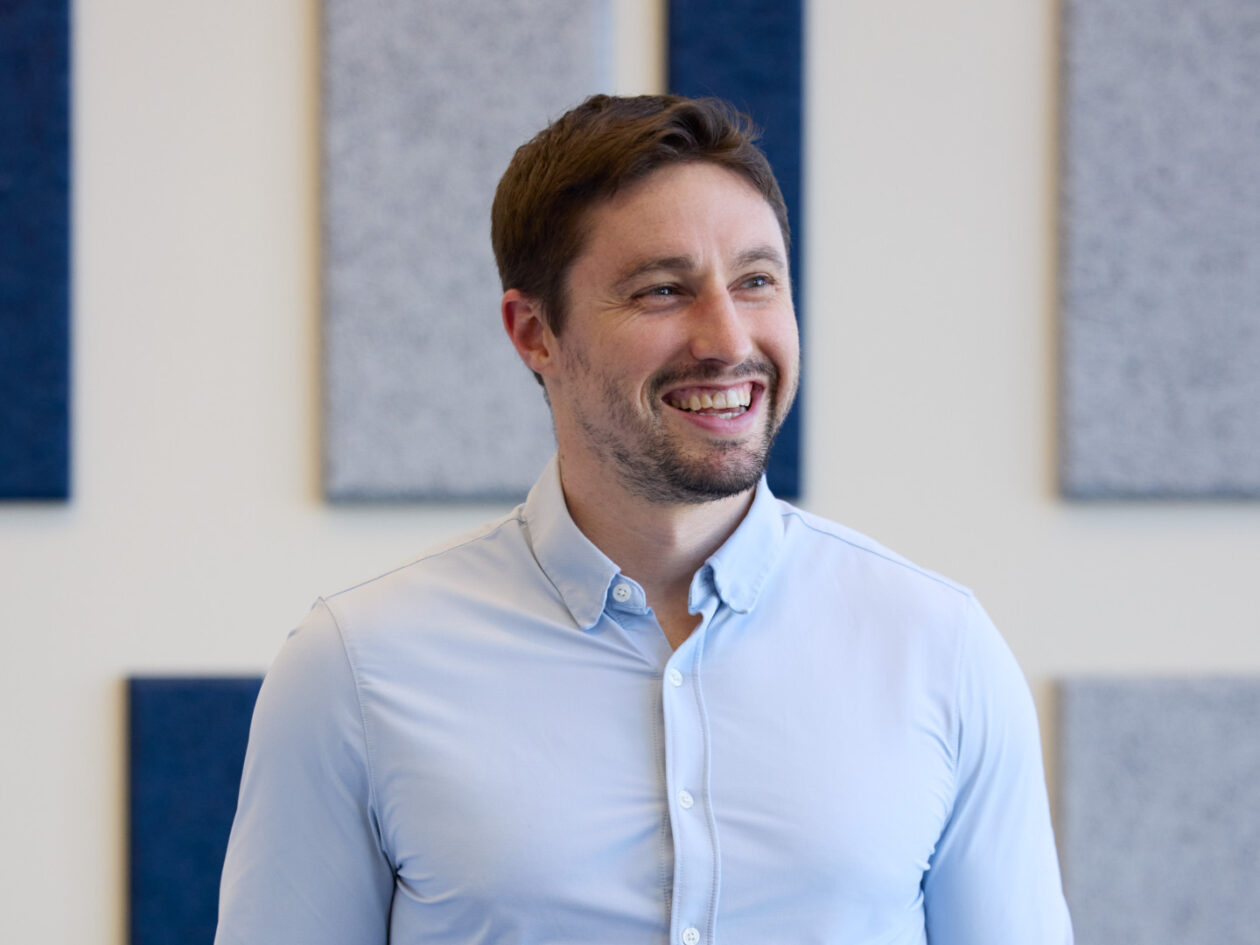
Matt Allen wasn’t sure he wanted to pursue a career at McKinstry, the Seattle-based company his grandfather co-founded in 1960. The business started with plumbing and piping, evolving into a construction and energy services firm with national reach.
But after joining in 2012, Allen began appreciating the impact McKinstry has helping customers find affordable, planet-friendly solutions for their operations.
It could be as simple as replacing an old, natural gas boiler with a high-efficiency heat pump, Allen said, “but you feel like you’re part of that customer’s journey, and our societal journey, to get to a carbon-free environment.”
Now serving as McKinstry’s chief client officer, Allen shared his thoughts with GeekWire about sustainability. His quotes have been edited for clarity and length.
What’s your biggest worry when it comes to solving climate change?
With all the expansion in energy consumption and the race for compute, I worry about maintaining our progress around decarbonization. And having a young son, I do worry about rising temperatures and what the world is going to look like for young people. However, I am encouraged to see a continued emphasis in decarbonization action across industries. On the data center side, the hyperscalers that we work with are evolving their designs to focus on sustainability as much as possible.
What gives you hope for the planet?
Human ingenuity has been able to innovate our way through challenging spots. Western Washington is a big hotbed for clean nuclear solutions, deep geothermal, and some of these new, emerging clean energy generation technologies. When enough brain power is focused on those pieces, combined with capital infusion, progress is made. I think there is a lot of motivation to increase clean energy generation through innovative solutions. That gives me hope.
If you could invent one sustainability solution overnight, what would it be?
Clean nuclear fusion. If you could accelerate Helion, Zap or Avalanche, that would be great. Or deep geothermal — Fervo Energy, for example, is developing a commercial project down in Utah. If we could snap our fingers and get some of those technologies to market, you could rapidly accelerate people’s willingness to electrify systems and connect to a clean grid. A lot of this comes back to having a clean grid, so when we’re doing electrification projects at a building level, the building owners can have confidence in having energy availability to reduce their carbon footprint.
What’s an underrated solution that deserves more attention?
Operations — that’s a big focus for us, finding optimized ways to operate buildings and turn down systems when appropriate. We joke that everyone talks about first cost when they’re building or doing a retrofit, but they don’t talk about the ongoing operation and maintenance costs. If we can find more efficient ways to operate buildings, that reduces strain on the grid and reduces overall energy consumption while providing real savings for our clients.
What’s one metric you watch obsessively?
We rigorously track greenhouse gas emissions. Our baseline started in 2019, around the time we signed the Amazon Climate Pledge, which has a net zero target of 2040. We hope to hit net zero sooner. We’re also tracking a couple of different measures. One is GHG emissions on a per-revenue basis. So, as we’re growing our revenue, are we still taking a bite out of emissions? We also track it on a per-FTE-employee basis. Those two measures hold us accountable as an institution to make sure we’re not taking our eye off the ball moving toward net zero.
The scope of the climate challenge is daunting — how do you approach this work?
For the work we do for customers, or even the work we do internally to reduce our own carbon footprint in our business operations, you just take it quarter by quarter, project by project — focus on doing a good job for your customers, bring things in on time and on budget, and help strategize with them on the most cost-effective ways to do things.
We do the same thing internally, creating a glide pattern. There is no magic bullet, so you take it one piece at a time. A good example for us is our biggest carbon emitter — our vehicle fleet. We have 600 service vans and another 300 utility trucks out on the road, and we track our progress toward electrifying that fleet. We’re 10 or 15% of the way through, and every time a vehicle needs to be replaced, we replace it with an electric one.
What impact do you hope your work has in 20 years?
I just hope that there isn’t an existential climate crisis, that we’ve taken collective action — whether it’s the Paris Climate Accord or some other macro commitment — and come together as a society to ensure we’ve left the campsite in a better place than we found it and that our world remains a habitable, thriving, healthy environment for the next generation to live in.
https://ift.tt/6W7ozmw August 24, 2026 at 02:21PM GeekWire
Post a Comment
0Comments