

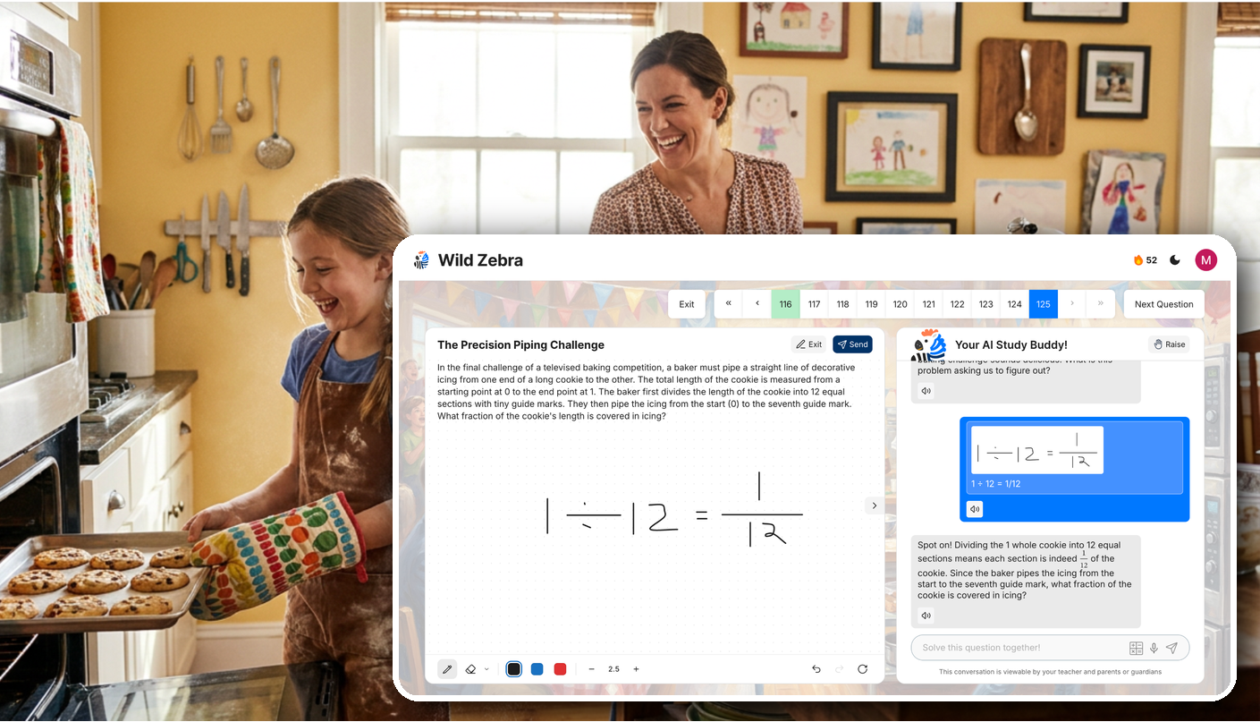
Seattle-based edtech startup Wild Zebra has raised $6 million to expand its AI learning platform for math and reading, citing early signs that its specialized product can hold its own against the free study tools released over the past year by OpenAI, Google and Anthropic.
One of Wild Zebra’s secrets is its Socratic approach: rather than handing over the answer, the platform works students toward it with questions, drawing out the reasoning step by step.
Another key difference: the lessons are customized to be grounded in whatever topics or hobbies the student is already interested in, such as sports, cooking, music, or anything else.
The platform also analyzes the conversations themselves, looking not just for students who are distracted or getting answers elsewhere, but for those showing persistence or curiosity — flagging those positive moments in dashboards for teachers and parents.
The idea is “to catch kids being good, too,” said edtech veteran Edan Shahar, the company’s CEO and co-founder.
Latest funding: The oversubscribed seed round was led by Bellevue, Wash.-based Trilogy Equity Partners, with participation from Tetherpoint Capital and angel investors including Shrikesh Majithia. It brings the company’s total funding to $8 million.

Wild Zebra, co-founded in 2024 by Shahar and longtime AI technologist Erik Selberg, serves students in grades 2 through 9. The company, with a team of 10, plans to use the new funding for hiring, primarily engineers, along with sales and marketing initiatives.
Trilogy Managing Director Amy McCullough, who is joining the Wild Zebra board, said the VC firm backed the company for its potential to give parents and teachers a real-time view of what a student has actually learned, and a path to mastering the material from there.
She said she came to the deal as a customer first: her family had used Test Innovators, the private-school admissions test-prep company Shahar ran for nearly a decade, and she was struck by how well it delivered for parents and students at a high-stakes moment.
“When we were introduced to Wild Zebra, we knew very quickly that this was the team who could build the student-centric AI partner for the market,” McCullough said.
Competitive landscape: When GeekWire first covered Wild Zebra last year, OpenAI and Google had just launched study modes of their own. Anthropic launched a free version of Claude for K-12 teachers last month, and Khan Academy’s Khanmigo has been in the market for years.
Shahar said the general-purpose chatbots are good at answering a single question or explaining a concept, but don’t keep track of what a student knows over time.
Wild Zebra builds what the company calls a “learning tree” for each student — what they’ve mastered, where the gaps are, what comes next — and uses it to decide what they work on next, rather than just responding to whatever they happen to ask.
Shahar sees the big AI labs as suppliers more than rivals. Wild Zebra runs on their models, along with others.
Traction so far: Wild Zebra says it now reaches tens of thousands of students, up from about 6,000 a year ago, and has logged hundreds of thousands of tutoring conversations.
It opened the platform to families this year at $48 per month per child. The first consumer customers, Shahar said, were parents at pilot schools who wanted it for their other kids.
On the school side, Wild Zebra works through E3n, formed this year by the merger of the Educational Records Bureau and the Enrollment Management Association, which serve selective private schools. ERB invested in the company in 2024.
Many member schools test students using E3n’s exams, and Wild Zebra uses those results to set each student’s starting point, though some schools using the platform don’t.
Early results: E3n also conducted a 722-student pilot evaluation of math and reading, measuring results against ERB norm groups collectively built from hundreds of thousands of students. It found gains of four to eight percentage points among fifth and sixth graders.
Having started in private schools, Wild Zebra is now talking with charter and public schools.
Shahar said schools and students skeptical of AI mostly don’t become customers, and the ones who do tend to share his optimism while still taking the risks seriously.
The concern he hears most often from students is AI’s environmental impact — which, he acknowledged, is not something Wild Zebra is working to address.
“I’m not a Pollyanna. I think there are certainly potential downsides to AI in general,” he said. “There are people working on the downside mitigation. I’m working on upside opportunity.”
https://ift.tt/AyzoaX6 August 6, 2026 at 02:12PM GeekWire
Post a Comment
0Comments