

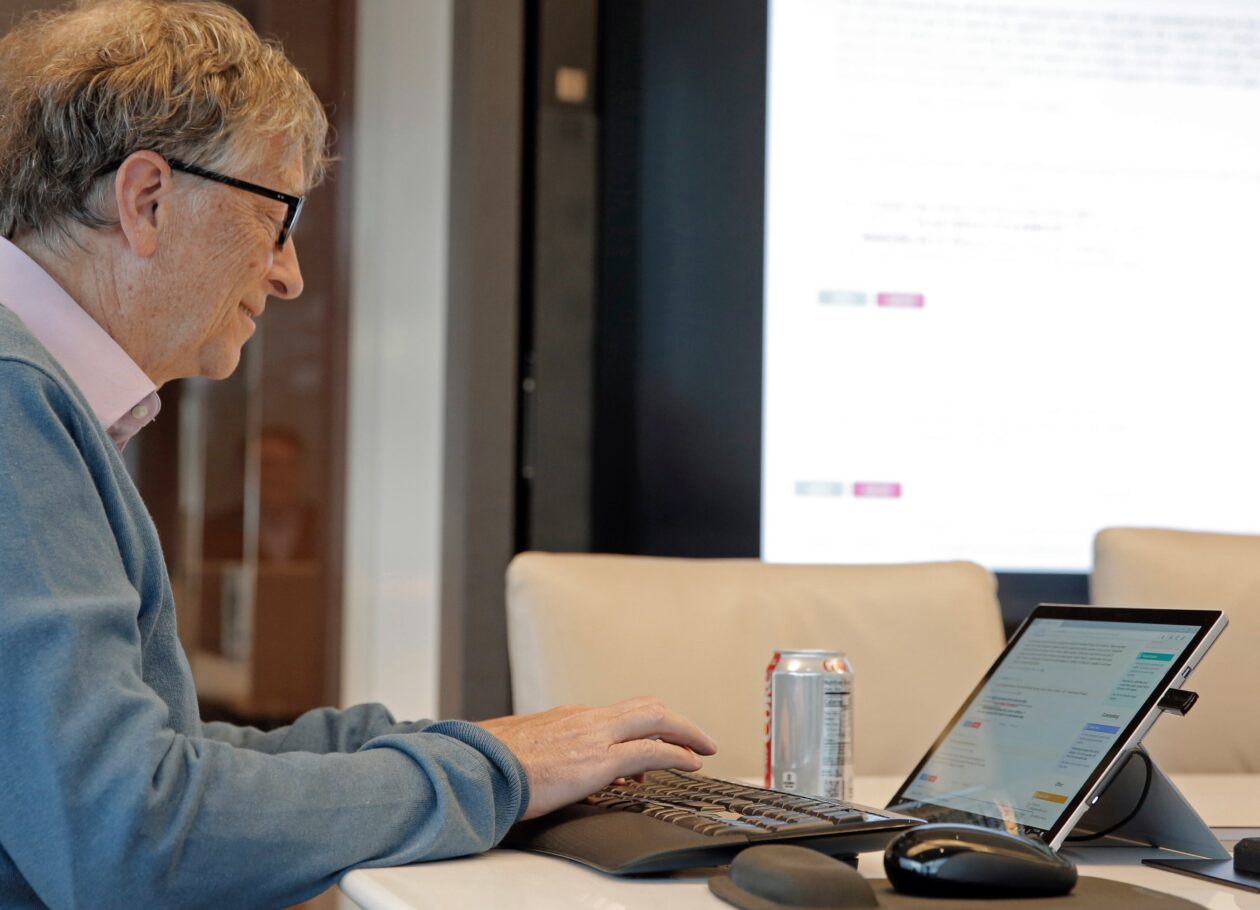
Bill Gates is legendary, bordering on notorious, for his late-night emails — missives to colleagues and associates with piercing questions about Java back in the day, or malaria these days, or whatever esoteric topic he happens to seize upon at any given moment.
But increasingly, he is sending these messages to AI, not to people. He’ll bounce something off Claude, get ChatGPT to weigh in, and insert himself in the middle.
He described the pattern in an interview with GeekWire: “It’s 3 a.m., I want to understand sodium batteries. Now, there’s no reason to go to sleep. Here we go! Yeah, it’s crazy.”
If you’re a curious person, he said, “this is a mind-blowing time.”
In terms of productivity, he added, “we are in heaven.”
All of which might be predictable. This is Bill Gates, after all. Now 70 years old, he has spent more than five decades impatient for the future to arrive — making the case that innovation, on the whole, will ultimately put humanity and the world in a better place.
So here’s the surprise twist: He’s now deeply concerned about where technology is headed.
In a new essay, Gates says the “turbulent AI era” has arrived, with technology threatening to erase categories of jobs, supercharge fraud and deepfakes, lower the bar for cyberattacks on critical infrastructure, make it easier to engineer a deadly new disease, let governments kill without humans involved in the decision, and fundamentally change how kids grow up.
If someone came up with a credible plan to slow the pace of AI globally, he writes, he’d likely support it. But he doesn’t expect one. The geopolitical and economic forces are too much.
He says the world needs to take action, and offers three ideas to start:
Build new institutions, at home and globally. No existing agency was designed for a technology that touches jobs, security, health, energy and elections all at once, he writes.
Gates calls for new national bodies that can set priorities across agencies, plus a new international organization modeled on nuclear weapons inspections, aviation rules and the ozone treaties.
Set aside jobs for humans. Gates calls this “Human Reserved”: work that machines will be fully capable of doing, but that we decide to keep for people anyway. The model is a nature reserve — land where we could build roads and buildings, but choose not to, because the loss would be too great.
One example: a robot delivering the news that you have an incurable disease. “There’s no technical reason why it couldn’t,” he writes. “Yet it shouldn’t.”
The idea came in part from watching the caregivers who looked after his father through Alzheimer’s, work he describes as “irreplaceably human.”
Tax AI tokens and robots. Today a company that hires a worker pays payroll taxes, while a company that buys a robot deducts the cost. Gates says that gives employers a reason to replace people. He’s calling for a tax on AI to change the incentives and help pay for retraining.
He first floated a robot tax nine years ago, but the idea was widely dismissed. He’s still for it. He acknowledges that it isn’t economically efficient, but says that with innovation accelerating, we can afford a little inefficiency as the price of keeping people employed.
Gates is candid that he doesn’t have all the answers, particularly on the proposal for “Human Reserved” jobs. Who decides what gets reserved, and by what criteria? How do you keep companies from using robots in the jobs that are supposed to stay human?
These, he writes, “will need to be worked out in public.”
In the meantime, he’s working it out with Claude. Gates said he has talked the idea through with the chatbot, thinking through different ways to get the share of work reserved for humans up to 40%, using shorter workdays and earlier retirement to spread what’s left around.
Crossing the threshold
In the interview, Gates said the essay came out of a specific realization: the AI industry is blowing past its own warning signs, one after another, and almost nobody is saying so out loud.
For years, he said, people in AI described certain moments as dangerous points where the industry would stop and think hard before going further: making it easier to build a bioweapon, making it easier to launch a cyberattack, building machines people become emotionally dependent on, wiping out large numbers of jobs, and losing control of the technology itself.
“We’re in the process of crossing every single one of those thresholds,” he said.
Meanwhile, nobody in the industry wants to be first to step on the brakes. “Most people you talk to will say, yeah, well, if everybody else would slow down, maybe I would, too,” he said.
Gates said one way out of that standoff is for governments to step in.
His example: any AI model capable of designing new molecules — the capability that would let someone engineer a new disease — should be monitored. The monitoring would be mandatory rather than voluntary, and it would cover free models as well as commercial ones. It would also have to be written so a company can’t copy the model elsewhere and strip the monitoring out.
“To me, that’s kind of like common sense,” he said. “But we don’t see a specific proposal to do that.”
‘The whole thing seems so empty to me’
Under an executive order signed by President Trump in June, AI companies are asked to submit their most powerful models for government testing up to 30 days before release. The order specifically bars the program from becoming a licensing or preclearance requirement. The White House finalized the framework in early August.
Gates said he doesn’t get it.
“What is the threshold that’s being examined, and what is the action taken when you cross that threshold?” he said. “The whole thing seems so empty to me.”
If the world can’t take these basic steps, he said, “I really am going to throw up my hands.”
If the process stays voluntary, with no line and no consequence for crossing it, “we’re going to look back on this as a kind of eye-of-the-storm type moment,” he said.
Asked if he had taken his proposals to the Trump administration or to other heads of state, Gates said with a bemused tone, “Well, you could tell me who at the White House I should be talking to about this.” He said he hopes the essay reaches people in Congress and in the executive branch.
He said the public argument among AI companies over whether the risks are real is beside the point, because privately the people running them already agree. “I know they’re all worried,” he said, “or all of them that I know, which is basically everybody but Elon.”
People inside AI companies who acknowledge the downsides, Gates said, get told: “Hey, you’re hurting our PR while we’re trying to raise trillions of dollars.”
Gates said he previously expected losing control of AI to be a distant problem, something to worry about “many years from now.” He’s no longer convinced that’s the case.
He referenced an Aug. 11 episode of the Dwarkesh Patel podcast featuring Ryan Greenblatt, chief scientist at the AI safety group Redwood Research. Greenblatt said that as AI systems get more capable, the people building them understand less and less about what is happening inside, and that sufficiently advanced models could end up working against their creators.
“These are people who are super expert on the thing, going, well, maybe we won’t be able to control these things,” Gates said. “I mean, what kind of risk have we chosen to run here?”
In the poorest countries, he expects AI to do more good than harm. Doctors, classrooms and support for farmers are scarce in the countries the Gates Foundation works in, and AI can supply versions of all three. The foundation will lay out that work at its Goalkeepers event next month, including an effort to make AI models work as well in African languages as they do in English.
The job losses, he added, will hit rich countries first.
The AI Road Ahead
For all of this, Gates is still thinking about how technology will change human life and productivity, in many ways for the better on an individual level.
- A key step, he said, will be establishing broad-based persistent memory for AI agents across contexts. For now, AI still doesn’t know you like a human assistant who’s familiar with your relationships and how you think about your time.
- Gates sees the role of apps changing in the future. Instead of bouncing between different pieces of software, he said, AI will increasingly be the primary interface. “You won’t go to those applications,” he said. “You’ll just go to your personal agent.”
- He also sees AI continuing to transform shopping, to an extreme: “We will get to a point where you won’t buy things yourself. You just won’t.” Telling the agent to help you buy something, “it’ll consider so many more things, and it’ll make it so much easier for you to do it.”
Asked whether he is still an optimist, Gates didn’t answer directly. “I don’t think being pessimistic is helpful,” he said.
“I do think, wow, this is sure an interesting time. I’m the guy who in my 30s thought people in their 50s or 60s didn’t understand anything.” He called it “kind of bizarre” that he would be delivering a message like this at 70.
“But I am very concerned. And honestly, when you get people one-on-one, so are they.”
https://ift.tt/Cb4iluK August 26, 2026 at 07:27AM GeekWire
Post a Comment
0Comments